Photo via Fast Company
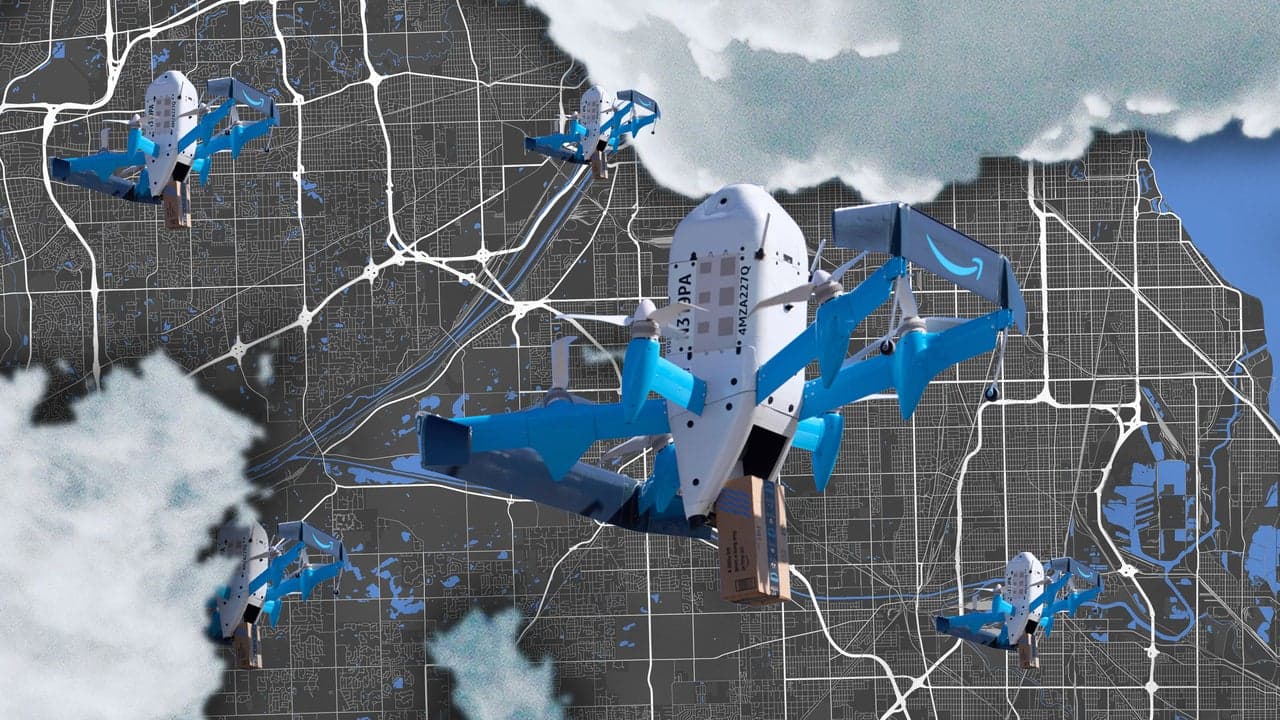
Amazon's push to scale Prime Air drone delivery to 500 million packages annually within a decade is accelerating real-world testing across eight U.S. cities, with four more planned soon. According to Fast Company, Chicago's south suburbs will host trials this spring or summer, allowing residents within an eight-mile radius of Amazon's Matteson and Markham warehouses to receive small packages via autonomous aircraft. The company's FAA-approved MK30 drones weigh 80-85 pounds, operate at speeds up to 73 mph at 400 feet altitude, and use onboard AI systems for autonomous navigation—capabilities that highlight the technological ambition behind last-mile delivery transformation.
However, documented incidents signal emerging safety risks that merit serious attention from regulators and business leaders. A January 2026 Amazon drone crash in Richardson, Texas ricocheted off an apartment building before striking the sidewalk and emitting smoke. Earlier incidents include two Prime Air drones colliding with a crane in 2025, hospitalizing a worker, and a Wing food-delivery drone igniting power lines in Brisbane, Australia, leaving 2,000 customers without electricity. While direct injuries remain limited, the accumulating evidence suggests that accident rates may climb as drone traffic intensifies and multiple vendors operate simultaneously in shared airspace.
The regulatory framework governing this expansion appears underdeveloped relative to the operational timeline. The FAA's Office of Advanced Aviation Technologies, which oversees Chicago's trial with minimal public transparency, lacks specific community safety protocols or incident-reporting mechanisms. Amazon's website provides general assurances but no detailed information on how high-value package security will function, neighborhood disruptions from hovering aircraft, or citizen reporting procedures for equipment failures. This gap contradicts the FAA's own "Innovate 2028" mandate requiring public understanding of how drone operations will affect communities—a requirement neither Amazon nor the regulatory agency appears to be fulfilling adequately.
Beyond Amazon's ambitions, the competitive landscape promises further congestion: Wing partners with FedEx and Walgreens, UPS conducts its own trials, Flytrex operates as an aggregate drone service, and air-taxi companies like Joby Aviation expand into metropolitan airspace. Transportation experts note that successful coordination requires not just technical infrastructure but "sociability"—established communication standards, interoperable systems, and public accountability mechanisms. As multiple vendors and aircraft types multiply in low-altitude urban and suburban airspace, the question becomes whether current FAA capacity and AI systems can manage that complexity safely, or whether public support and business confidence will erode before the system scales.