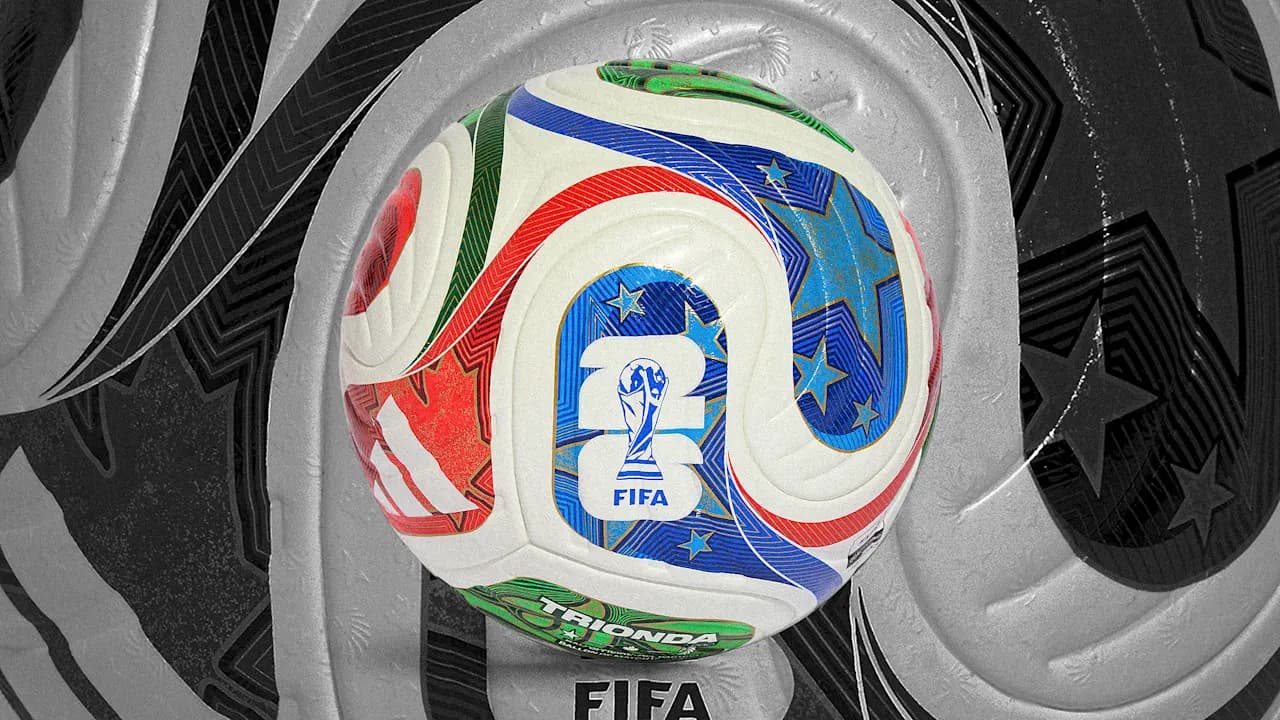
Photo via Fast Company
Every four years, the FIFA World Cup introduces a new official soccer ball, and this year's release marks a significant engineering milestone. According to Fast Company, Adidas has unveiled the Trionda, featuring a historic four-panel design—the fewest panels in men's World Cup history. The ball's distinctive red, blue, and green graphics celebrate the three host nations: Canada, the United States, and Mexico, with corresponding maple leaf, star, and eagle motifs. This design evolution represents decades of aerodynamic research and manufacturing innovation.
The challenge facing Adidas engineers was balancing aesthetics with performance. The Jabulani ball used in the 2010 World Cup became infamous for unpredictable dips and swerves, prompting designers to learn from that misstep. The Trionda addresses this through intentionally deep seams, pronounced grooves, and fine surface texturing despite its minimal panel count. Wind tunnel testing at the University of Tsukuba revealed that the ball reaches its drag crisis at approximately 27 mph—lower than previous designs—creating more stable aerodynamic behavior during corner kicks and free kicks that define competitive play.
Manufacturing and technology firms involved in sports equipment production, including those serving regional athletic markets, should note the implications of connected-ball technology integrated into the Trionda. The ball features an embedded chip that communicates with video assistant referee systems and semi-automated offside detection, marking an evolution in how officiating technology interfaces with equipment itself. This advancement reflects broader industry trends toward smart equipment and real-time data integration in professional sports.
For Nashville-area businesses in manufacturing, materials science, or sports technology sectors, the Trionda's development illustrates the market opportunity in precision equipment designed for global sporting events. The engineering required to balance four-panel construction, aerodynamic surface texturing, and embedded electronics demonstrates how specialized expertise commands premium positioning in the sports equipment market. As sports continue integrating advanced technology, companies capable of developing and validating complex equipment systems will find growing demand from major sporting organizations worldwide.